
If you manage an older commercial building, there’s a good chance you’ve heard someone refer to its roof as a “tar and gravel roof.” The name sounds old-fashioned, but Tar and Gravel Roofing describes an approach closely associated with traditional built-up roofing (BUR), a layered low-slope system that continues to have practical applications on commercial properties.
So, does that mean you should automatically keep the same system when it’s time for major repairs or replacement? Not necessarily. Today’s commercial roofing market offers several alternatives, and the smartest decision starts with understanding what is actually on your building, how it’s performing, and what you need from the next roof.
Let’s break down tar and gravel roofing without making it more complicated than it needs to be.
What Is Tar and Gravel Roofing, Really?
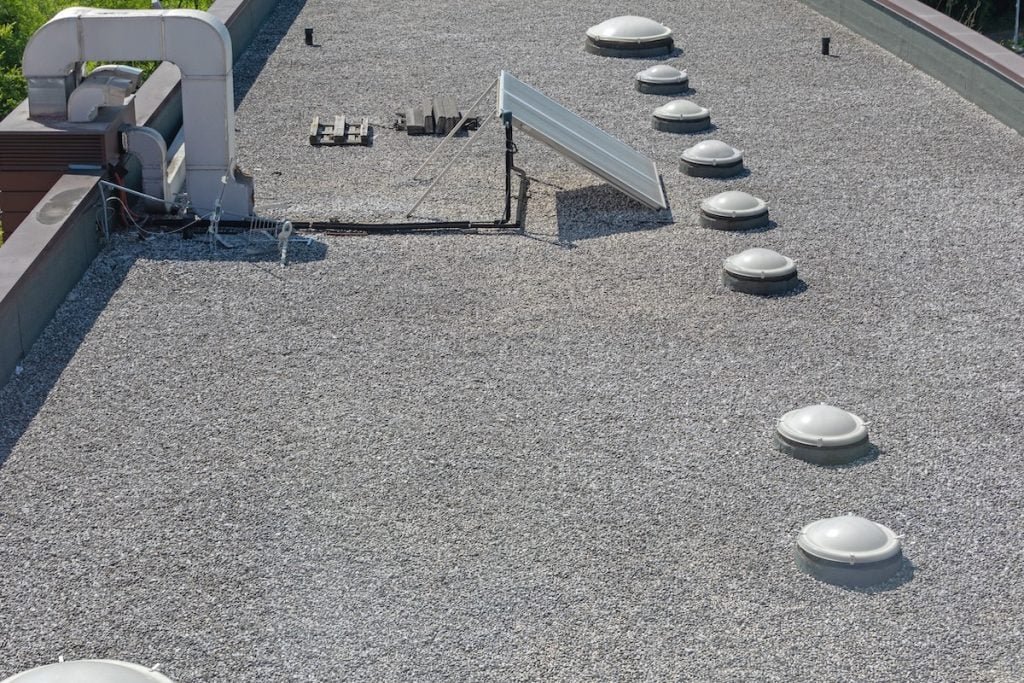
When people say “tar and gravel,” they’re usually talking about a traditional form of built-up roofing. BUR creates waterproofing through multiple reinforcing plies incorporated with bituminous materials. In aggregate-surfaced systems, stone or gravel provides a protective layer over the roofing assembly.
One important clarification: “tar and gravel” is often used as a casual umbrella term. Not every modern built-up roofing assembly literally uses coal tar. Asphalt-based bituminous systems are also common, so identifying the existing material correctly matters before repairs are specified.
The basic concept, however, is easy to understand. Instead of relying on one primary membrane sheet, the roof is built through multiple layers. Those layers work together to create the waterproofing assembly, while the aggregate surface can help protect the materials beneath it.
What might a complete commercial roof include? Depending on the design, you’ll find some combination of:
- Roof deck or suitable substrate
- Insulation and other specified assembly components
- Multiple reinforcing plies
- Bituminous materials
- Flashing at transitions and penetrations
- Aggregate or another specified protective surfacing
That layered design is one reason BUR has remained recognizable for so long. But here’s the important part: more layers don’t automatically mean a better roof. Installation quality, drainage, flashing, substrate conditions, and ongoing maintenance remain critical.
“A durable roof isn’t created by one impressive material. It’s created when every layer and every detail work together.”
Why Do Commercial Buildings Still Use This Layered System?
With TPO, PVC, EPDM, and other modern options available, you might wonder why anyone would still consider built-up roofing. The answer is straightforward: different buildings benefit from different roofing characteristics.
BUR’s multi-ply construction provides waterproofing redundancy. Rather than asking a single primary sheet to form the roof’s waterproofing layer, reinforcing plies and bituminous materials create an integrated assembly. For owners who value a substantial multi-layer approach, that can be attractive.
Protective aggregate surfacing can also help shield underlying roofing materials from ordinary exposure and some forms of rooftop wear. That’s useful on commercial buildings where maintenance personnel occasionally need to access mechanical equipment.
Still, you shouldn’t select a roofing system simply because it has been used successfully elsewhere. A warehouse, office property, retail building, and industrial facility can have very different structural conditions, rooftop traffic, equipment, drainage requirements, and operational priorities.
Quick Tip
If you’re considering Reinforced Commercial Roofing in the Bay Area, start with an assessment of the existing building—not a predetermined roofing material. Review the deck, drainage, insulation, penetrations, rooftop equipment, repair history, and structural considerations before comparing systems.
This is particularly important when replacing an existing tar and gravel roof. Staying with BUR may make sense, but replacement is also an opportunity to evaluate whether the building’s current needs have changed since the previous roof was installed.
Where Can Tar and Gravel Roofing Create Challenges?
No roofing system comes without trade-offs, and tar and gravel roofing is no exception. One obvious consideration is the nature of the assembly itself. Depending on the design, BUR and aggregate surfacing can introduce different weight and installation considerations than lighter single-ply alternatives.
Aggregate can also make visual inspection and leak investigation less straightforward in some situations because portions of the underlying roofing surface aren’t immediately exposed. When a leak appears inside, simply searching directly above the water stain may not reveal the actual entry point.
Then there are the usual trouble spots found across low-slope commercial roofs. Pay particular attention to:
- Drains and scuppers where debris can restrict water movement.
- Flashing at walls, curbs, and transitions.
- Penetrations for vents, pipes, and mechanical equipment.
- Previous repairs that may require further evaluation.
- High-traffic areas around regularly serviced rooftop equipment.
Why focus so much attention on these smaller areas? Because a broad roof field may remain in reasonable condition while a relatively small transition allows water into the building. **The most visible part of the roof isn’t always the part most likely to need attention.**
Drainage deserves special attention as well. Commercial roofs commonly described as “flat” are actually low-slope systems designed to direct water toward drains, scuppers, or other outlets. If those pathways become restricted or the roof develops areas where water does not drain as intended, additional stress can be placed on vulnerable details.
And what about maintenance crews? HVAC technicians, electricians, and other contractors may need to cross the roof regularly. A durable roofing assembly can still be damaged by dropped tools, dragged equipment, disturbed flashing, or poorly planned new penetrations.
That’s why a strong roof-management plan considers not only weather exposure but also how people actually use the rooftop.
Repair, Restore, or Replace—How Do You Decide?
Finding a leak doesn’t automatically mean your tar and gravel roof needs replacement. If the problem is localized and the surrounding assembly remains serviceable, a compatible repair may be the most sensible response.
The decision becomes more complicated when leaks keep returning or deterioration appears in multiple areas. At that point, repeatedly patching visible symptoms can become less useful than stepping back and evaluating the complete roofing assembly.
A professional assessment should help answer several practical questions:
- Is deterioration localized or widespread?
- Are there signs that moisture may have affected underlying components?
- Are drainage or flashing problems contributing to recurring leaks?
- Is the existing roof a reasonable candidate for restoration?
- Would replacement provide a more appropriate long-term strategy?
Restoration can sometimes occupy the middle ground between isolated repairs and complete replacement. When existing conditions are suitable, a restoration approach may correct identified deficiencies and renew protective elements without removing the entire roofing assembly.
But there’s an important catch: **restoration only makes sense when the roof is actually a suitable candidate.** Covering widespread deterioration or unresolved moisture concerns doesn’t make those conditions disappear.
Replacement becomes a stronger consideration when deterioration is extensive, repairs are becoming increasingly frequent, underlying conditions are unsuitable for restoration, or the existing system no longer aligns with the building’s needs. Even then, don’t assume that another tar and gravel roof is automatically the answer.
Replacement creates an opportunity to compare BUR with TPO, PVC, EPDM, or other appropriate low-slope systems. The goal isn’t to declare one technology universally better. It’s to find the system whose characteristics best match your property.
Is Tar and Gravel Roofing Right for Your Building Today?
Maybe—and that’s a more useful answer than an automatic yes or no. Tar and gravel roofing can still make sense when the building is well suited to a substantial multi-ply assembly and the owner values the characteristics of built-up construction.
But roofing decisions should reflect today’s building, not yesterday’s specification. Has new mechanical equipment been installed? Has rooftop traffic increased? Are there recurring drainage concerns? Have insulation requirements or operational priorities changed?
Those questions matter because commercial buildings evolve. The roofing system needs to work with the property as it exists now and with the way you expect to operate it in the future.
Installation quality should remain central to that decision. A carefully selected membrane cannot compensate for poorly resolved flashing, inadequate attention to drainage, unsuitable substrate conditions, or careless penetrations. The roof works as an assembly, which means every component has to support the same objective.
Maintenance completes the picture. Routine professional inspections, clear drainage pathways, controlled rooftop traffic, documented repairs, and prompt attention to developing problems give you a much better understanding of how the roof is changing over time.
A Smarter Way to Protect Your Commercial Roof
Tar and gravel roofing has been around long enough that it’s easy to think of it simply as an “old” roofing system. That’s misleading. What matters isn’t whether the technology is traditional or modern; what matters is whether its characteristics fit the commercial building you’re trying to protect.
If you already have a tar and gravel roof, start with its condition. Find out what’s working, what isn’t, where water is moving, how previous repairs are performing, and whether underlying components require further investigation. Then decide whether repair, restoration, or replacement makes sense.
If you’re planning a new roof, take the same building-first approach. Compare systems according to structural requirements, drainage, rooftop operations, installation logistics, maintenance expectations, and long-term property goals.
Because in the end, the best commercial roofing decision isn’t about choosing the oldest technology or the newest one. **It’s about choosing a complete roofing system that makes sense for your building—and maintaining it well after installation day.**